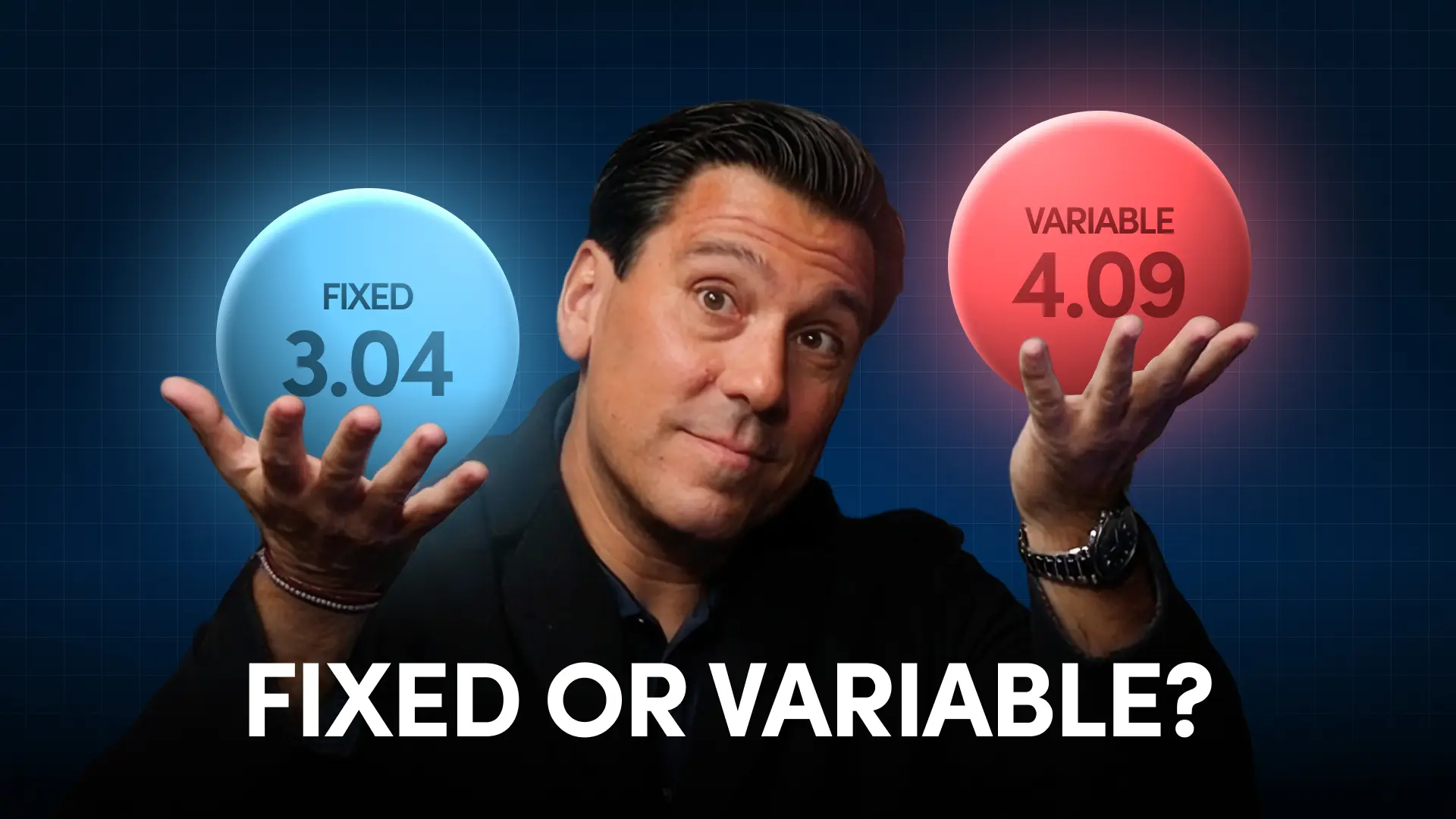
In this week’s episode of Make Money Count, Marcus and Justin tackle the question they heard more than any other at the Toronto Home Show this past weekend: should you choose a fixed or variable mortgage? Here’s how they break it down, and why Marcus is betting against the market on this one.
Where Rates Stand Right Now
Right now, the best variable rate is around 3.4%, and the best fixed rate is just above 4%, at about 4.09%. Before getting into which one makes more sense, Marcus and Justin start with how each rate actually gets set, since the answer to a fixed or variable mortgage decision depends on what drives each one.
How Each Rate Is Priced
A variable rate is priced off the Bank of Canada’s overnight rate, which sits at 2.25% today. The Bank uses that rate as a tool: it raises it to slow inflation and lowers it to encourage borrowing and economic growth. Every time the Bank of Canada raises its rate, a variable rate mortgage goes up with it.
A fixed rate works differently. It’s priced off Government of Canada bond yields. Since Canadian mortgages are largely guaranteed by the government, a mortgage’s yield should roughly match a government bond’s yield, plus an added margin. Marcus puts that margin at somewhere between 1% and 1.5%, which covers the cost of servicing the mortgage and the extra risk compared to a plain bond.
Why the Odds of a Hike Dropped
The chance of a Bank of Canada rate hike on October 28 has been swinging all month. At one point it was close to 100%. Two weeks before recording, it was around 70%. Today, it’s under 50%.
The biggest reason is the US jobs report that came out on October 2. It showed 29,000 jobs added versus an expected 84,000, a big miss. That pulled US and Canadian bond yields down and lowered the odds of a Canadian hike. It came after the Fed’s September 16 hike, which had initially strengthened the case that the Bank of Canada would need to follow.
A Canadian Economy That Gives the Bank Reason to Hold
The Canadian numbers add to the case for holding. Canada lost 42,000 jobs in August, the unemployment rate is 6.4%, and wages are up only about 2%. Core inflation is hovering around 2%, while headline inflation sits at 3%. Tariffs are adding further pressure on the economy.
Not everyone agrees. Scotiabank is one bank that doesn’t expect the Bank of Canada to hold. And Marcus and Justin are clear about the risk on the other side: if the Bank holds and inflation gets out of hand, borrowers could end up in a worse spot.
What the Market Chart Says, and Why Marcus Disagrees
Marcus walks through a chart that plots the implied probability of a hike at every Bank of Canada meeting over the next year. Taken at face value, it says rates will be about 110 basis points higher a year from now. His own words: if the market is right, you should take a fixed rate mortgage today.
But he’s betting against it. He believes markets tend to be overly optimistic about how far rates will rise, and that the predicted path will shift as conditions change. He also usually chooses a variable rate mortgage himself, partly because of how much he dislikes the penalty to break a fixed rate.
Why Banks Charge You More to Break
This is the part of the episode that ties directly to the title. Marcus is blunt about it: if you’re with a bank, the penalty to break a fixed rate mortgage is steep, and he says banks are built to extract the maximum penalty from you.
His alternative is a mortgage finance company such as MCAP, First National, or Merix Financial, which he names as one of the main reasons to look beyond a bank in the first place. They’ll go deeper into this in the next episode, including a point worth waiting for: when rates rise sharply, penalties actually come down.
If You Have a Renewal or Purchase Coming Up
Whichever way you lean on a fixed or variable mortgage, Marcus and Justin share one piece of advice for anyone with a renewal or purchase on the horizon: lock in a rate now. That applies even if your renewal is a year or two away. If rates climb in the next few months, you’ll have the held rate in hand, and if it makes sense, you can break and switch. You can also take it to your current bank as leverage when you ask them to drop your rate.
What This Episode Is Really About
The fixed or variable mortgage question comes down to two different bets: where the market says rates are headed, and where you think they’ll actually land. Marcus makes his case for variable, the market’s own pricing points to fixed, and the penalty to break a fixed rate adds a cost that many borrowers don’t think about until they need out.
Not sure what your mortgage options are? Talk to a Cannect expert now.
Watch the full episode of Make Money Count for the complete breakdown. Subscribe to the Cannect YouTube channel for weekly mortgage and real estate insights you will not find anywhere else.